
If you’re looking for a cross-country car shipping quote right now, there’s a decent chance you’re going to have a little sticker shock.
We get it. Car shipping prices are high right now — in some cases, a lot higher than customers were seeing at the beginning of the year. And there’s one big reason for it: diesel fuel.
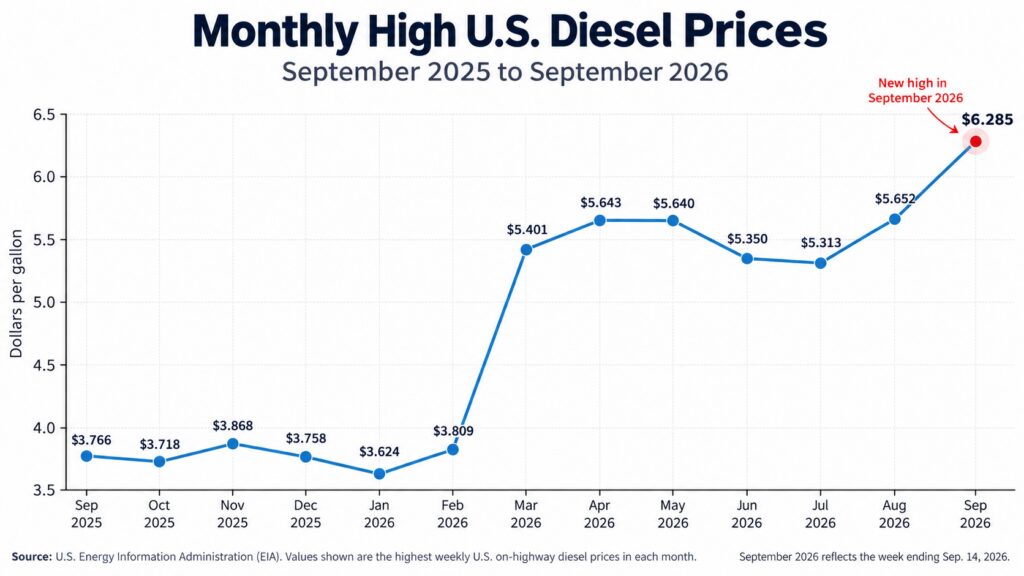
We closely monitor diesel prices using data from the U.S. Energy Information Administration (EIA). The EIA releases national diesel price data weekly, and its most recent report showed the average U.S. on-highway diesel price at $6.29 per gallon as of September 14, 2026.
Because EIA data is only updated once a week, we can also look at AAA for a more current daily snapshot. As of September 16, AAA reported the national average diesel price at $6.31 per gallon — which was also the highest national diesel average AAA had recorded.
So yes, diesel prices really are historically high. And when diesel goes up this much, the cost to ship a car goes up with it.
Why Do Diesel Prices Have Such a Big Impact on Car Shipping?
This one is pretty simple. Car carriers run on diesel.
Whether your vehicle is traveling on a smaller 3-car trailer or a large 9-car hauler, fuel is one of a carrier’s biggest operating expenses. On a long-distance transport, a truck can burn hundreds of gallons of diesel before the trip is over.
When diesel was in the $3.00-$4.00 range, that was already a significant expense. At more than $6.00 per gallon, the math changes in a hurry.
Carriers can’t absorb an increase like that forever. Their fuel costs go up, so the amount they need to charge to move vehicles goes up too. Those higher carrier rates then work their way into the car shipping quotes customers see.
As a carrier and a licensed broker we’re seeing these higher fuel costs from both sides. As a carrier with our own fleet of trucks, we’re paying those higher diesel prices ourselves every time one of our trucks hits the road. As a licensed auto transport broker working with thousands of partner carriers across the country, we’re seeing the same pressure on their rates.
Whether your vehicle moves on one of our trucks or with one of our carrier partners, the impact of higher diesel prices is very real.
That’s the trickle-down effect we’re dealing with right now.
Why Can Car Shipping Prices Change So Quickly?
This is probably the most frustrating part of the current market.
Diesel prices aren’t just high — they’re extremely volatile.
The U.S. Energy Information Administration reported a national weekly diesel average of $5.599 per gallon on August 31. Two weeks later, on September 14, that average had jumped to $6.285. That’s an increase of nearly 69 cents per gallon in just two weeks.
When fuel costs are moving that fast, carrier pricing moves fast too.
That means if you get a car shipping quote today and get another new quote five days from now, you may see a different price. We’re constantly monitoring what carriers are accepting on different routes and adjusting our pricing as market conditions change.
We know customers don’t like surprises. Neither do we.
Our goal has always been to be as straightforward as possible about pricing. If market conditions have changed and the price to get your vehicle moved is different than what you previously saw, we’ll let you know up front and explain what changed.
Why Are Diesel Prices So High Right Now?
There isn’t one single cause. Several things are putting pressure on diesel supplies and prices at the same time:
- Global oil supplies and shipping routes have been disrupted. Oil exports from the Middle East remain constrained, and disruptions involving major shipping routes such as the Strait of Hormuz and the Bab el-Mandeb Strait have reduced the amount of oil reaching global markets.
- Russian refinery production has been disrupted. Ukrainian attacks on Russian energy infrastructure have significantly reduced Russian refinery runs and exports of refined petroleum products, adding even more pressure to an already tight diesel market.
- Diesel inventories are unusually tight. The EIA expects U.S. inventories of distillate fuel oil — which includes diesel — to fall below 100 million barrels and remain below the recent five-year range. Low inventories leave less of a cushion when supplies are disrupted and contribute to higher diesel prices.
- Crude oil prices have climbed sharply. Brent crude recently climbed to nearly $109 per barrel, up significantly from the roughly $91-per-barrel average in August. Since crude oil is the primary raw material used to make diesel, higher crude prices are another major factor pushing diesel costs higher.
Sources: EIA, IEA, EIA, Investing.com
In other words, there are a lot of moving pieces right now, which is why diesel prices can change so dramatically from week to week.
We’re Navigating It Right Along With You
We’ve been shipping vehicles for a long time (over 25 years now), and we’ve seen fuel prices rise and fall many times. What makes the current market especially challenging is how quickly prices are moving.
We can’t control the price of diesel, and neither can the carriers we work with.
What we can do is keep a close eye on the market, adjust as quickly as possible, and be honest with our customers about what it currently takes to get a vehicle moved.
So if you get a car shipping quote today and think, “Wow, that seems expensive,” you’re not imagining it.
Car shipping is expensive right now. Diesel is a major reason why.
Unfortunately, none of us can control what diesel prices do or where they go from here. What we can do is continue watching the market closely, adjusting as conditions change, and being as transparent as possible with our customers about what’s happening and why.
Hopefully, understanding what’s driving today’s higher car shipping prices makes those numbers a little less surprising when you request a quote.
If you need to ship a vehicle, get an instant quote to see what your route costs in today’s market. And if you have questions about the price, give us a call. We’ll be happy to walk you through it.